Showing posts with label Etruscans. Show all posts

Friday, November 30, 2007

Friday Archaeology Blogging
Pre-Roman Italy Edition


So, I thought today that I'd babble on about some of the peoples inhabiting Italy prior to the Roman domination. There were quite a number, many of them ethnically or linguistically related to the Romans, and some of them definitely not. Here's a small sample, working roughly from the South of the peninsula to the North. I've provided only very brief notes about them - perhaps I'll take one of them and do a much fuller Friday Archaeology Blogging about them at another time.

Lucanians: A people related to the Samnites, the Lucanians took over the southern part of Italy during the 5th century B.C., expelling the previous inhabitants (the Oenotrii and Ausones on the map). They almost immediately lost the region of the Calabria to insurrection on the part of the Bruttii, however. The Lucanians fairly quickly got crosswise of the Romans, and suffered badly after backing Hannibal during the 2nd Punic War (218-202 B.C., roughly). Although they managed to get up again to fight the Romans in 90-88 B.C., during the so-called Social War, they were beaten badly again, and faded into insignificance.


The Lucanian sanctuary at Rossano di Vaglio - I was there this summer!

Samnites: Of all the indigenous peoples of Italy (leaving aside the Etruscans for the moment), the Samnites probably came closest to upstaging the Romans. In fact, they came very, very close. In 321 B.C., the Samnites inflicted upon the Romans a humiliating defeat at the Battle of the Caudine Forks in south-central Italy, forcing the defeated Roman survivors to pass under a yoke as a symbol of their surrender.

The Samnites inhabited the region of the Appennine Mountains, just to the South of Rome, bordering Lucanian territories, and spoke a language related to Latin. They warred with the Romans throughout the last half of the fourth century B.C., before being overcome early in the third. A brief rebellion in the 80s B.C. was, according to the sources, punished with extreme ferocity by Lucius Cornelius Sulla, and the Samnites basically fade from history at that point, although the name "Samnite" was given to a particular style of gladiator (there is, in fact, some evidence that the Romans copied the conept of gladiatorial combat from the Samnites).


A Samnite bronze helmet.

Umbrians: The Umbrians were a very, very old people, first attested archaeologically in the 9th century B.C. Dwelling in what is still called Umbria, to the East of the Etruscans, they spoke a language related to Latin. Although conquered by the Romans in the third century B.C., the Umbrians generally managed to avoid the kind of devastation that was visited on peoples like the Lucanians; they seem to have simply gradually romanized over time. They were granted Roman citizenship in 90 B.C., mostly as a reward for not opposing Rome too energetically during the Social War.

Etruscans: Ah, the mysterious Etruscans... Speaking a language that is most definitely not related to Latin, and in fact may even be non-Indo-European, the Etruscans exercised dominion over North-central Italy until the rise of Roman powers. Indeed, the Etruscans in fact at times held considerable power over Rome itself. Even after the end of Etruscan independance (more or less the beginning of the first century B.C.), ethnic Etruscans continued to occupy important positions in the Roman political hierarchy.

The main debate over the Etruscans, of course, revolves around who the heck they were. Some scholars have proposed a middle-eastern origin for them (the foundation myths of some Etruscan cities involve the fall of Troy), while others suggest that the Etruscans were in fact autochthonous, descendants of the earlier Villanovan culture. The jury is pretty much still out on this one.


An Etruscan fresco from Orvieto.

Non-Indigenous Inhabitants: A brief word is in order about those peoples who came to Italy from elsewhere before the rise of the Romans. The main group here is the Greeks, who had heavily colonized the southern part of the peninsula and Sicily beginning in about the 7th century B.C. Sicily, in particular, became a fairly major player in the Greek world before finally being absorbed by the Romans. They had significant contact, obviously, with the Lucanians, and there's a fair bit of research that's being done (some of it by a very good friend of mine), on exactly what that relationship was like. The influence of the Greeks on southern Italy cannot be overstated; to this day, there are remote communities in Calabria whose dialect of "Italian" is in fact ancient Greek.

The other non-indigenous group roaming around Italy during the pre-Roman period that bears mentioning is the Celts. The Celts, at various times, passed through and even settled in parts of Italy. In fact, in 390 B.C. they sacked and burned the city of Rome, in retaliation for the Romans having opposed them in an earlier fight against a different city. The only reason, according to legend, that Rome survived at all, was that many of its inhabitants took shelter in the town's citadel, a relatively defensible position. An attempted night raid on the citadel by the Celts had the misfortune to stumble into an enclosure containing sacred geese, who objected loudly to this intrusion and woke the defenders. One group of Celts who are known to have been in Italy is the tribe known as the Boii, who inhabited the Adriatic coast for a while. Upon being driven from Italy, the moved North, and settled in the area of modern Slovakia, a region to which they gave the name "Bohemia."

I realize here that I have not even barely scratched the surface of the topic of pre-Roman Italy; indeed, there are scholars who base their life's work on minor aspects of even one of the cultures listed above (or of one of a number of other pre-Roman cultures - I've by no means been comprehensive here!). However, I think it's worthwhile just to get the names out there, and to remind people that the Italian peninsula was not a monolithically Roman geographic entity!

Sunday, April 22, 2007


Friday Archaeology Blogging

This is what happens when you take a break from blogging; you forget what you're supposed to be doing on Friday afternoons.

Anyway, as mentioned in the last post, I'm heading off across the water next week, to do a couple of months' worth of what Alison from Creekside referred to as "bones-bothering." I'll be here, more or less:


Lake Trasimene - Click for larger version


We've got a number of projects on the go this summer. Excavation will continue at a Roman villa site we've been digging since 1992, but we've also got a couple of interesting survey projects starting up. In both cases, the sites involved are suspiciously flat-topped hills, with not much growing on top of them. We're going to go and wander around and see what's lying on the ground on both these hills. My betting is that we'll find more Etruscan stuff than Roman, but that's just a guess at this point.

However, the area is significant to Roman history and archaeology, and I know precisely what the Umbrian Archaeological Superintendency wants us to find; they're hopeing that we'll over definitive proof of the location of the Battle of Lake Trasimene, fought in 217 B.C. This battle was one of the worst disasters ever suffered by Rome; the Roman army was lured into a massive ambush by the brilliant Carthaginian general Hannibal, and pretty much annihilated. Oodles of circumstantial evidence exists suggesting that the battle was fought along the western half of the north shore of the lake, although the battlefield itself has never been precisely identified.


Hannibal

We're not going to be particularly interested in finding the battlefield this time out; if we do, it will be more or less by accident. What we are interested in doing is studying the transition in the area between the Etruscan civilization and the Roman, a somewhat nebulous process usually referred to as "Romanization." For my part, my own interests lie somewhat later, in what scholars have referred to as the
"Third-Century Crisis." The mid-3rd century A.D. has usually been portrayed as a time of economic depression and depopulation in the rural areas of central Italy, but archaeological evidence is starting to argue against that, at least near Lake Trasimene. What I'm interested in discovering is whether this evidence is an aberation, or part of a larger regional pattern, and I'm hoping that our hill-walking this summer will provide at least some clues concerning the third century.

Friday, March 24, 2006

Friday Archaeology Blogging

On coffins, etc.

Ancient Coffin Depicts Scenes from Homer's Odyssey, Iliad
By George Psyllides
Associated Press
posted: 21 March 2006
11:07 am ET

NICOSIA, Cyprus (AP) -- A 2,500-year-old sarcophagus with vivid color illustrations from Homer's epics has been discovered in western Cyprus, archaeologists said Monday.


And there it is (click on it to see a bigger version). You can quite clearly see a chariot containing two warriors, with the man in front driving, and the fellow behind him carrying a bow. The horse appears to be trampling somebody, and there's another chariot coming up behind the one shown. There's no telling which bit of the Iliad or Odyssey it's depicting - people riding around in chariots form a big part particularly of the Iliad. Here's a sample:

Aeneas answered, "Say no more. Things will not mend till we two go
against this man with chariot and horses and bring him to a trial of
arms. Mount my chariot, and note how cleverly the horses of Tros can
speed hither and thither over the plain in pursuit or flight. If
Jove again vouchsafes glory to the son of Tydeus they will carry us
safely back to the city. Take hold, then, of the whip and reins
while I stand upon the car to fight, or else do you wait this man's
onset while I look after the horses."
"Aeneas." replied the son of Lycaon, "take the reins and drive; if
we have to fly before the son of Tydeus the horses will go better
for their own driver. If they miss the sound of your voice when they
expect it they may be frightened, and refuse to take us out of the
fight. The son of Tydeus will then kill both of us and take the
horses. Therefore drive them yourself and I will be ready for him with
my spear."
They then mounted the chariot and drove full-speed towards the son
of Tydeus. Sthenelus, son of Capaneus, saw them coming and said to
Diomed, "Diomed, son of Tydeus, man after my own heart, I see two
heroes speeding towards you, both of them men of might the one a
skilful archer, Pandarus son of Lycaon, the other, Aeneas, whose
sire is Anchises, while his mother is Venus. Mount the chariot and let
us retreat. Do not, I pray you, press so furiously forward, or you may
get killed."
Iliad, Book V.

Homeric scenes are not especially rare on sarcophagi, which is not surprising considering the popularity of the works in ancient times. Here's another example (once again, click on it to see the bigger picture), showing a scene from the Odyssey.


"I had hardly finished telling everything to the men before we
reached the island of the two Sirens, for the wind had been very
favourable. Then all of a sudden it fell dead calm; there was not a
breath of wind nor a ripple upon the water, so the men furled the
sails and stowed them; then taking to their oars they whitened the
water with the foam they raised in rowing. Meanwhile I look a large
wheel of wax and cut it up small with my sword. Then I kneaded the wax
in my strong hands till it became soft, which it soon did between
the kneading and the rays of the sun-god son of Hyperion. Then I
stopped the ears of all my men, and they bound me hands and feet to
the mast as I stood upright on the crosspiece; but they went on rowing
themselves. When we had got within earshot of the land, and the ship
was going at a good rate, the Sirens saw that we were getting in shore
and began with their singing.
"'Come here,' they sang, 'renowned Ulysses, honour to the Achaean
name, and listen to our two voices. No one ever sailed past us without
staying to hear the enchanting sweetness of our song- and he who
listens will go on his way not only charmed, but wiser, for we know
all the ills that the gods laid upon the Argives and Trojans before
Troy, and can tell you everything that is going to happen over the
whole world.'
"They sang these words most musically, and as I longed to hear
them further I made by frowning to my men that they should set me
free; but they quickened their stroke, and Eurylochus and Perimedes
bound me with still stronger bonds till we had got out of hearing of
the Sirens' voices. Then my men took the wax from their ears and
unbound me.
Odyssey, Book XII

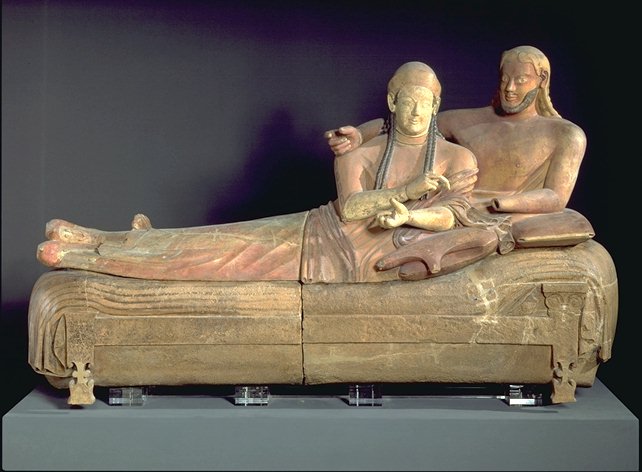
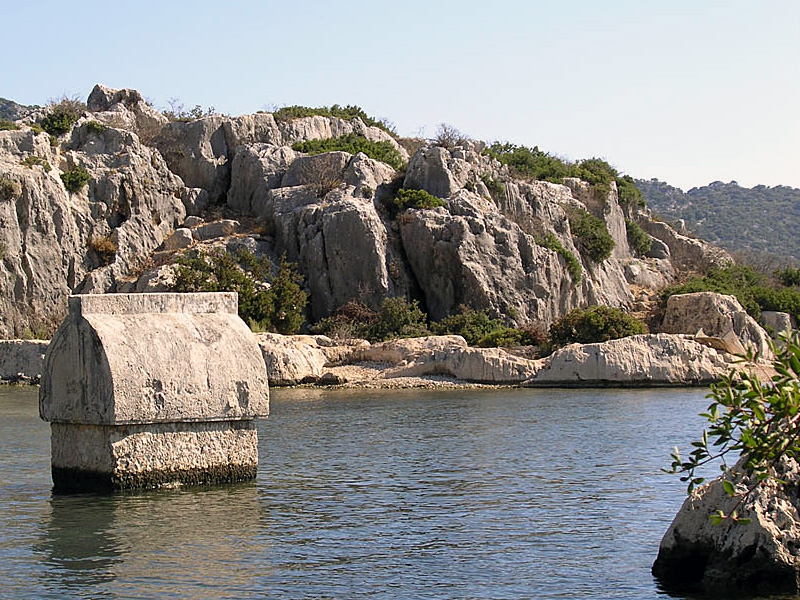
Anyway, there's not too much to this week's Friday Archaeology Blogging; I really just wanted to show some nice pictures of sarcophagi (the word, incidentally, literally means "flesh-eating," and refers to the limestone commonly used in their construction, which caused the bodies within to decompose rapidly). I would point out that they are intrinsically interesting as objets d'art, in particular those made by the Etruscans. For one thing, early Etruscan sarcophagi are our only real source of information on what Etruscan houses looked like:


For another, they occasionally included detailed, life-sized, representations of the people buried within:


I will close this brief digression on sarcophagi by saying only that I would very badly like to know the story behind this one: